
Βίος Αγίου Δημητρίου. - Jeta e Shën Dhimitrit
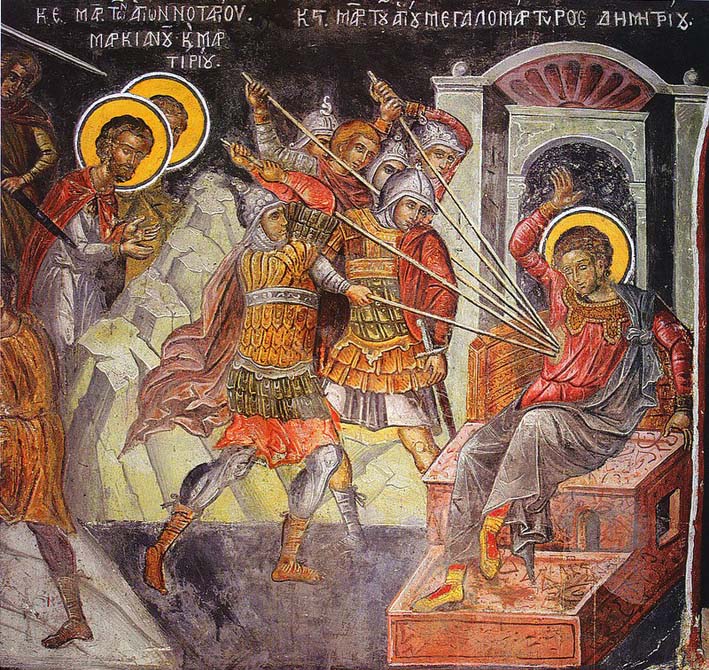
.Ο Άγιος Δημήτριος γεννήθηκε περί το 280 - 284 μ.Χ. και μαρτύρησε επί των αυτοκρατόρων Διοκλητιανού και Μαξιμιανού το 303 μ.Χ. ή το 305 μ.Χ. ή (το πιο πιθανό) το 306 μ.Χ.
Ο Δημήτριος ήταν γόνος αριστοκρατικής οικογένειας στη Θεσσαλονίκη. Σύντομα ανελίχθηκε στις βαθμίδες του Ρωμαϊκού στρατού με αποτέλεσμα σε ηλικία 22 ετών να φέρει το βαθμό του χιλιάρχου. Ως αξιωματικός του ρωμαϊκού στρατού κάτω από τη διοίκηση του Τετράρχη (και έπειτα αυτοκράτορα) Γαλερίου Μαξιμιανού, όταν αυτοκράτορας ήταν ο Διοκλητιανός, έγινε χριστιανός και φυλακίστηκε στην Θεσσαλονίκη το 303 μ.Χ., διότι αγνόησε το διάταγμα του αυτοκράτορα Διοκλητιανού «περί αρνήσεως του χριστιανισμού». Μάλιστα λίγο νωρίτερα είχε ιδρύσει κύκλο νέων προς μελέτη της Αγίας Γραφής.
Στη φυλακή ήταν και ένας νεαρός χριστιανός ο Νέστορας (βλέπε 27 Οκτωβρίου), ο οποίος θα αντιμετώπιζε σε μονομαχία τον φοβερό μονομάχο της εποχής Λυαίο. Ο νεαρός χριστιανός πριν τη μονομαχία επισκέφθηκε τον Δημήτριο και ζήτησε τη βοήθειά του. Ο Άγιος Δημήτριος του έδωσε την ευχή του και το αποτέλεσμα ήταν ο Νέστορας να νικήσει το Λυαίο και να προκαλέσει την οργή του αυτοκράτορα. Διατάχθηκε τότε να θανατωθούν και οι δύο, Νέστορας και Δημήτριος.
Οι συγγραφείς εγκωμίων του Αγίου Δημητρίου, Ευστάθιος Θεσσαλονίκης, Γρηγόριος ο Παλαμάς και Δημήτριος Χρυσολωράς, αναφέρουν ότι το σώμα του Αγίου ετάφη στον τόπο του μαρτυρίου, ο δε τάφος μετεβλήθη σε βαθύ φρέαρ που ανέβλυζε μύρο, εξ ου και η προσωνυμία του Μυροβλήτου.
Στις βυζαντινές εικόνες αλλά και στη σύγχρονη αγιογραφία ο Άγιος Δημήτριος παρουσιάζεται αρκετές φορές ως καβαλάρης με κόκκινο άλογο (σε αντιδιαστολή του λευκού αλόγου του Αγίου Γεωργίου) να πατά τον άπιστο Λυαίο.
Σήμερα ο Άγιος Δημήτριος τιμάται ως πολιούχος Άγιος της Θεσσαλονίκης.
Ένα από τα πολλά θαύματα του Αγίου είναι και το εξής. Το 1823 μ.Χ. οι Τούρκοι που ήταν αμπαρωμένοι στην Ακρόπολη της Αθήνας ετοίμαζαν τα πυρομαχικά τους για να χτυπήσουν με τα κανόνια τους, τους Έλληνες που βρισκόντουσαν στον ναό του Αγίου Δημητρίου, μα ο Άγιος Δημήτριος έκανε το θαύμα του για να σωθούν οι Χριστιανοί και η πυρίτιδα έσκασε στα χέρια των Τούρκων καταστρέφοντας και τμήμα του μνημείου του Παρθενώνα. Για να θυμούνται αυτό το θαύμα, ο ναός λέγεται από τότε Άγιος Δημήτριος Λουμπαρδιάρης, από την λουμπάρδα δηλαδή το κανόνι των Τούρκων που καταστράφηκε.
.....................................

Shën Dhimitri lindi rreth viteve 280-284 pas Krishtit në qytetin e Selanikut në vitet kur perandor ishte përndjekësi fanatik i të krishterëve,Dhioklitiano.
Rridhte nga një familje aristokrate.Dhimitri ishte një djalë i pasur me virtyte dhe vecori.Për aftësitë e tij të rralla,u rendit shpejt në gradat e ushtrisë romake dhe në moshën 22 vjecare morri titullin e oficerit.
Megjithë ngarkesën dhe detyrimet e tij si oficer, Shën Dhimitri nuk ndaloi të kryente detyrat e tij si i krishterë për përhapjen e së vëtetës më Krishtin,duke ndihmuar kështu të gjithë ata që jetonin në errësirë dhe adhuronin idhujt.
Kur e mësoi perandori këtë gjë urdhëroi ta arrestonin.Shën Dhimitri pohoi me krenari para perandorit besimin e tij te Krishti dhe për këtë ai urdhëroi ta burgosin dhe t’i nënshtrohet torturave.
Në burg gjendjej dhe një nxënës i Shën Dhimitrit, Nestori i cili do përballej në arenë me gjigandin Lieo.Nestori i shkoi pranë dhe kërkoi nga Shën Dhimitri bekimin e tij. Sapo doli në arenë Nestori thërriti:”Perëndi e Dhimitrit më ndihmo” dhe e mposhti gjigandin Lieo.
Kjo ngjarje e shtoi më tepër urrejtjen dhe i inatin e perandorit dhe urdhëroi menjëherë ti vrisni të dy.
Shën Grigor Palamai shkruan se trupi i tij u varros në vendin e martirizimit.Nga varri i Shën Dhimitrit dilte erë miro dhe për këtë u quajt Shën Dhimitër Mirovliti.
Shën Dhimitër Mirovliti është Shenjti mbrojtës i qytetit të Selanikut.
Lipsani i tij ndodhet në Kishën kushtuar Shenjtorit,në Selanik
Kremtimi i Shën Dhimitrit festohet më 26 tetor.
Rridhte nga një familje aristokrate.Dhimitri ishte një djalë i pasur me virtyte dhe vecori.Për aftësitë e tij të rralla,u rendit shpejt në gradat e ushtrisë romake dhe në moshën 22 vjecare morri titullin e oficerit.
Megjithë ngarkesën dhe detyrimet e tij si oficer, Shën Dhimitri nuk ndaloi të kryente detyrat e tij si i krishterë për përhapjen e së vëtetës më Krishtin,duke ndihmuar kështu të gjithë ata që jetonin në errësirë dhe adhuronin idhujt.
Kur e mësoi perandori këtë gjë urdhëroi ta arrestonin.Shën Dhimitri pohoi me krenari para perandorit besimin e tij te Krishti dhe për këtë ai urdhëroi ta burgosin dhe t’i nënshtrohet torturave.
Në burg gjendjej dhe një nxënës i Shën Dhimitrit, Nestori i cili do përballej në arenë me gjigandin Lieo.Nestori i shkoi pranë dhe kërkoi nga Shën Dhimitri bekimin e tij. Sapo doli në arenë Nestori thërriti:”Perëndi e Dhimitrit më ndihmo” dhe e mposhti gjigandin Lieo.
Kjo ngjarje e shtoi më tepër urrejtjen dhe i inatin e perandorit dhe urdhëroi menjëherë ti vrisni të dy.
Shën Grigor Palamai shkruan se trupi i tij u varros në vendin e martirizimit.Nga varri i Shën Dhimitrit dilte erë miro dhe për këtë u quajt Shën Dhimitër Mirovliti.
Shën Dhimitër Mirovliti është Shenjti mbrojtës i qytetit të Selanikut.
Lipsani i tij ndodhet në Kishën kushtuar Shenjtorit,në Selanik

Kremtimi i Shën Dhimitrit festohet më 26 tetor.
ENVER HOXHA - THE DICTATOR OF ALBANIA - A BIG ΤΥRΑΝΤ IN A SMALL COUNTRY

One of the more interesting minor dictators of the 20th century was Enver Hoxha of Albania.
Hoxha was born in Albania in 1908, while it was still a province of the Ottoman Empire.
The son of a wealthy cloth merchant, he was educated in France, where he became a communist. He was teaching grammar school when Albania was invaded and conquered by Italy in 1939.
Hoxha helped organize the communist partisan resistance and was elected first secretary of the Albanian Communist Party in 1943.
The partisans liberated Albania in November 1944, and Hoxha became prime minister. In 1944, Hoxha broke with Josip Broz Tito and the Yugoslavian communists over the issue of Kosovo.
A great admirer of Josef Stalin, Hoxha kept Albania closely allied to the Soviet Union until after Stalin’s death in 1953.
Viewing Khruschchev and company as revisionists who had abandoned the true path to communism, Hoxha eventually broke with the Soviet Union and allied Albania to the People’s Republic of China under Mao Tse-tung.
Relations with China soured after Chinese rapprochement with Tito’s Yugoslavia and Chinese reduction in aid to Albania.
Hoxha then declared China also to be a revisionist state, with Albania as the only true remaining Marxist-Leninist state in the world.
Internally, Hoxha’s regime was one of the most repressive in the world. Religion was ruthlessly eradicated. Archbishops, bishops, priests and nuns were tortured and executed in mass. A total of 2,169 churches and mosques were demolished.
All private property was confiscated, and landowners, merchants and recalcitrant peasants were executed.
All contact with the outside world was cutoff because people attempting to enter or leave Albania were summarily executed.
The secret police were everywhere, and every stray comment was recorded.
The Albanian Communist Party was regularly purged, with possible rivals eliminated before they became too powerful.
Industrialization, initially sparked by aid from the Soviets and China, fell by the wayside when aid was cut off. By the time of Hoxha’s death in 1985, Albania was the poorest country in Europe and one of the most backward nations in the world.
After his death, Hoxha’s body was initially housed in an enormous white pyramid-shaped mausoleum and shrine designed by his daughter.
After the fall of communism, his body was removed and buried, and the former mausoleum now houses the International Cultural Center. (Text from Rick Miller's article in Linn's Stamp News)
Εγγραφή σε:
Αναρτήσεις (Atom)